
£4m to Boost Marine Robotics Research Capabilities

The UK’s National Oceanography Centre (NOC) has been awarded £4 million to bring next-generation sensing capabilities to its marine autonomous systems fleet for use in advancing sustainable ocean science.
The funding, from the Natural Environment Research Council’s (NERC’s) Future Marine Research Infrastructure (FMRI) programme, will support three projects by leading scientists and engineers at NOC to develop advanced sensors targeting 10 different biogeochemical essential ocean variables, from physics to nutrients and carbon. These will then be integrated on to autonomous underwater vehicles such as gliders and NOC’s Autosub Long Range (ALR).
These advances will then be made available to the UK marine science community through the UK’s National Marine Equipment Pool, the largest centralised marine scientific equipment pool in Europe, as part of the National Marine Facilities, managed by NOC.
“This investment underscores NOC’s position as a global leader in marine technology capability and innovation, accelerating the development and uptake of sensors with the capacity to transform marine science through the deep expertise in our Ocean Technology & Engineering group,” says Julie Robidart, who leads the group.
“By translating our innovation into science-ready autonomous capabilities, we’re supporting FMRI’s vision for a modern, versatile and sustainable marine research infrastructure.”
“By accelerating the adoption of sensor innovation, this investment will help to position the UK at the cutting-edge of marine research capabilities,” says Kristian Thaller, FMRI Programme Director. “It will ensure that UK marine science can meet society’s urgent need to observe, understand and predict changes in the ocean.”
The funding from NERC’s FMRI programme supports its Accelerating Adoption of Sensor Innovation (AASI) initiative, which aims to show how innovation in marine sensor technology can be translated into deployable autonomous research capabilities.
The funding will support three cutting-edge sensor development projects, the integration of these sensors into autonomous platforms, enhancing data management systems and targeting comprehensive validation trials by summer 2026.
The three sensor projects are:
Autonomous Sensors for fast In-situ Measurements of nutrient Ocean Variables (ASIMOV) – led by Dr Allison Schaap, will increase performance, speed, and reliability of nitrate and phosphate lab-on-chip sensors for use on Teledyne Slocum gliders.
Marine Sensors for Carbon Observations (MaSCOt) – led by Dr Socratis Loucaides, is a project to advance and optimise for use on gliders high-accuracy and precision lab-on-chip sensors for the marine carbonate system.
SixSense – led by Dr Andrew Morris, and as previously announced, will create a miniature multi-parameter sensor capable of measuring six key parameters covering biogeochemical, physical and environmental measurements (conductivity, temperature, dissolved oxygen, pressure, pH and Eh), to be integrated onto ALRs, gliders and other platforms, such as submersibles and profiling floats.
The FMRI programme mission is to revolutionise marine research infrastructure to deliver cutting-edge marine research capabilities so that science can serve society’s need to observe, understand and predict change in the ocean.
News
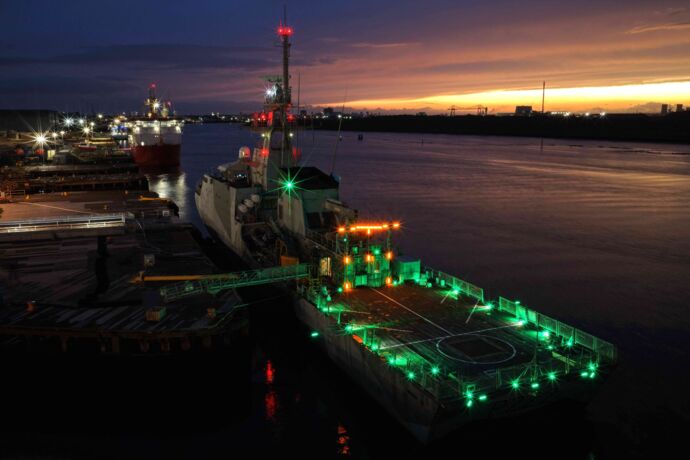
Innovative helicopter landing system installed on third Royal Navy ship at UK Docks
UK Docks Marine Services has helped install an advanced Heli Deck Lighting System on the Royal Navy's HMS Forth, improving helicopters' ability to…

Member Zone
If your company is a member of the Society of Maritime Industries a number of resources are available for which a log-in is required.
LoginResources
Access a wide range of documents, consultations and newsletters which we feel will aid your business activities.
Become a member
We promote the interests of UK based companies in the international market place and to governments
Join Us See the BenefitsNewsletter Signup
Keep up to date with all the latest news and events with our regular newsletter delivered straight to your email box.
Sign Up NowMarine Autonomy Challenge (MAChallenge)
This exciting biennial challenge is open to teams of students studying at UK universities.
Learn more