
Maritime Career Path Map
One of SMIFutures’ driving objectives within the maritime industry is to encourage the next generation of talent into the sector, whether school leavers, university graduates, or career‑changers.
To support this, SMIFutures drew on the experiences of the wider SMI community to understand the different routes people take into the industry. We received a strong response, culminating in the creation of our newly released career path map, which visually captures real career journeys across the maritime sector.
According to the Organisation for Economic Co‑operation and Development (OECD), the global ocean economy doubled over the 25 years from 1995 to 2020, from US$1.3 trillion to US$2.6 trillion, growing at an average annual rate of 2.8%[1]. During this period, the United Kingdom remained among the world’s top five ocean economies. Maritime UK and the Centre for Economics and Business Research (Cebr) State of the Maritime Nation report showed that in 2019 Britain’s maritime industry generated £116 billion in turnover — more than rail and air combined[2]. From 2010 to 2019, direct employment in the UK maritime sector rose by 18%, alongside growth of around £2.3 billion in employee compensation[2].
The maritime sector, both globally and within the UK, is undergoing significant change, driven by national security considerations, climate change, and rapid technological innovation. In the coming years, impacts are expected from the energy transition, digitalisation, and emerging technologies such as machine learning, automation, and artificial intelligence. Against this backdrop, the UK continues to see major success stories, including the T26 and T31 programmes, AUKUS, Artemis Technologies’ zero‑emission ferries, and the National Oceanography Centre’s autonomous underwater vehicles.
Alongside defence programmes, the UK maritime sector is also seeing strong commercial growth across clean maritime, autonomy, offshore energy, and marine science. From zero‑emission vessels and autonomous systems to offshore renewables and world‑leading ocean research, the sector offers a broad and expanding range of career opportunities aligned with future technologies and global challenges.
With advances in technology and evolving global pressures, the maritime industry is entering an exciting new era, offering diverse and impactful career paths for emerging professionals.
The SMIFutures Career Path Map was developed to showcase the expanding range of entry routes into the maritime sector, highlighting opportunities beyond traditional university pathways. It emphasises apprenticeships, routes from the armed forces, and opportunities for career‑changers, reflecting a modern industry open to talent from a wide range of backgrounds. The map also reflects non‑linear progression, showing how many individuals move between functions, sectors, and roles over time.
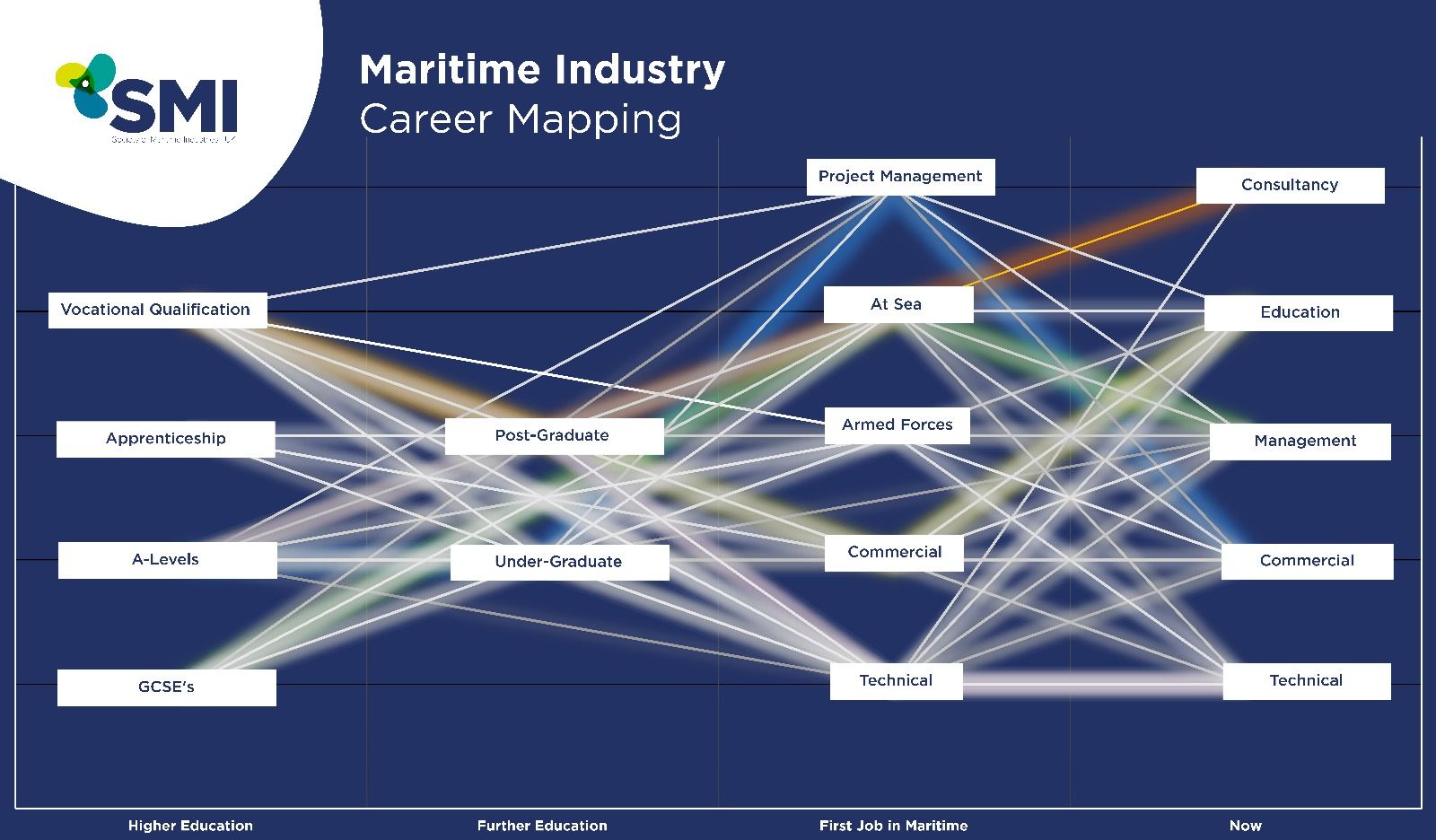
How to read the Career Path Map
This career path map is a static, illustrative view of the many routes people take into and through the maritime sector.
The map reads broadly from left to right. From education and early career stages, through first roles in maritime, to where individuals are now. The connecting lines represent real career journeys shared by people working across the UK maritime industry. There is no single “correct” route. The purpose of the map is to show the variety of entry points, career moves, and transitions that are possible, rather than to prescribe a set pathway. This map is intended as a high‑level overview and does not capture every possible role, qualification, or pathway within the sector.
At a glance: sector demographics
At a high level, the map provides insight into the current demographics reflected in our survey responses:
- Over 70% of respondents have completed further education (undergraduate, postgraduate, or PhD) at some point in their career
- Around 20% began their career at sea
- Around 15% started their career in the armed forces
- Only around 20% have remained in the same functional role as their first job in the industry
These figures highlight that while many individuals enter the sector through conventional routes, the industry offers significant scope for movement and progression. Most respondents have transitioned across functions, into management, or into education during their careers.
SMIFutures will continue to build on this work by sharing individual career stories and case studies that sit behind the pathways shown here. If you are considering a career in maritime — or supporting someone who is — this map is intended as a starting point for exploration and conversation. For more careers resources, visit the SMIFutures Student and Early Careers Hub.
[1] OECD - The Ocean Economy to 2050, [2] State of the Maritime Nation
News
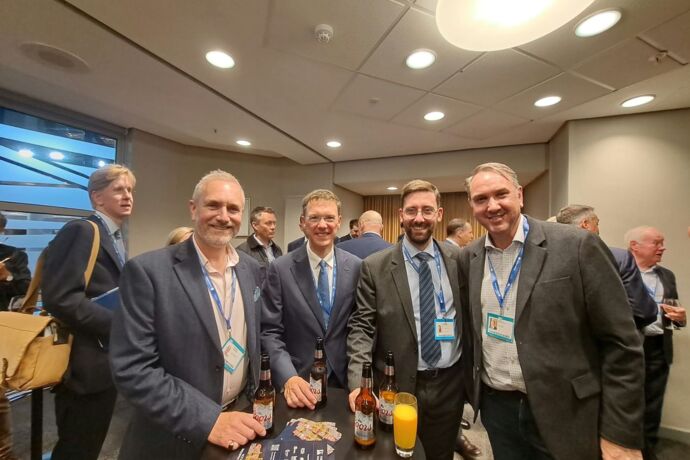
SMI Attends Conservative Party Conference 2026
The SMI team has been in Birmingham this week attending Conservative Party Conference 2026

Member Zone
If your company is a member of the Society of Maritime Industries a number of resources are available for which a log-in is required.
LoginResources
Access a wide range of documents, consultations and newsletters which we feel will aid your business activities.
Become a member
We promote the interests of UK based companies in the international market place and to governments
Join Us See the BenefitsNewsletter Signup
Keep up to date with all the latest news and events with our regular newsletter delivered straight to your email box.
Sign Up NowMarine Autonomy Challenge (MAChallenge)
This exciting biennial challenge is open to teams of students studying at UK universities.
Learn more