
Labour Party Conference Signals a Maritime Shift
The maritime debate surrounding Labour Party Conference 2026 extended beyond the speeches delivered in Liverpool. As delegates gathered on Sunday 27 September, the Cabinet Office announced that the National Shipbuilding Office would oversee all future civil ship procurement across government; the following day, Chancellor John Healey used his conference speech to place major investment in British shipbuilding within his vision for a “new age of industrialisation”. Although the announcements came through different channels, together they pointed towards a more strategic approach to maritime capability, connecting procurement more explicitly with economic growth, national security and industrial resilience.
That emerging approach matters because the UK maritime sector contributes far more than the construction of individual vessels. Shipyards rely on an extensive industrial network encompassing marine engineering, equipment manufacturing, systems integration, digital technologies, autonomy and through-life support, while businesses throughout that network require confidence in future demand before they can invest in facilities, innovation and specialist skills. The developments announced around conference deserve attention not simply for the programmes they initiate, but for what they reveal about the Government's developing approach to industrial strategy. At their core, these developments suggest a greater willingness to use public procurement not only to acquire assets, but also to support domestic capability, investment and long-term industrial resilience.
Why Long-Term Demand Matters
The Cabinet Office announcement gave the National Shipbuilding Office oversight of all future civil ship procurement across government, with the aim of creating a clearer and more predictable pipeline of demand and enabling a simpler route for procuring new vessels. The Government intends to provide further detail through the Shipbuilding and Maritime Technology Action Plan, which it plans to publish later this year.
For maritime businesses, greater visibility has practical value because companies can make stronger investment decisions when they understand where future opportunities may emerge, particularly where those decisions involve specialist recruitment, apprenticeships, new facilities, research and development or production capacity. A clearer pipeline cannot remove every source of commercial uncertainty, but it can give shipyards and suppliers greater confidence to prepare for future requirements rather than responding to each programme only after procurement begins.
The implications reach well beyond vessel builders. Marine engineering companies, equipment manufacturers, technology providers, systems integrators and specialist SMEs all contribute to vessel design, construction and through-life support, which means that a better coordinated procurement pipeline could support investment and capability throughout the wider maritime enterprise.
Viewed in this context, the NSO's expanded role could help government coordinate demand more effectively across departments while giving industry greater confidence to plan and invest for the future. These are priorities that SMI and its members have consistently advocated, alongside greater recognition of maritime’s contribution to growth, skilled employment and national resilience.
Shipbuilding as National Capability
John Healey reinforced that wider direction from the conference platform when he set out his vision for a “new age of industrialisation”. The Chancellor placed British shipbuilding within a broader agenda encompassing national security, economic growth and industrial resilience, while confirming substantial investment in strategically important maritime programmes.
Central to the announcement was Programme Euston, under which three new floating docks will support the Royal Navy’s submarine service at HM Naval Base Clyde. The Government will procure the docks through a UK-only competition because of their importance to national security and sovereign British industry, while the completed facilities will support inspections, upgrades and repairs for the UK’s current and future nuclear submarine fleet.
The programme responds to an immediate defence requirement, but its potential industrial significance extends further. A project of this scale can sustain specialist engineering capability, generate demand throughout the supply chain and give businesses greater confidence to invest in the people, technologies and facilities needed to support complex maritime programmes.
The Government also confirmed plans to replace the research vessel RV Cefas Endeavour. The new vessel will be built in the UK through a competition open only to UK shipyards and will lead a national system for monitoring the country’s seas, including fish stocks, pollution levels and seabed mapping. It will also use automation, robotics and artificial intelligence and run on clean fuels.
Although the two programmes serve different purposes, both illustrate a broader trend in government thinking. Procurement decisions are increasingly being linked to wider objectives around sovereign capability, skills, industrial resilience and economic growth, rather than being treated as purely transactional purchases.
From Individual Programmes to Industrial Strategy
The significance of these developments lies not in any single project, but in the connection between them. The NSO’s expanded remit could improve coordination and visibility across future civil procurement, while the vessel commitments show how specific programmes can support domestic capability and wider national objectives.
This approach requires government to look beyond the initial contract award and consider the conditions that allow the maritime industrial base to remain competitive over time. Shipyards cannot deliver complex vessels without specialist engineering, equipment, software, systems integration and through-life services, while suppliers cannot maintain those capabilities without sufficient confidence to invest in their workforce and productive capacity.
A more strategic procurement pipeline could therefore support much more than vessel construction. It could encourage innovation, strengthen supply-chain resilience and improve the ability of UK businesses to compete for opportunities at home and overseas, provided that policy intent develops into credible and deliverable programmes.
Ultimately, industry will judge these developments not by the announcements themselves, but by whether they translate into a visible and credible pipeline of future work. What the developments surrounding conference offered was a clearer indication that the Government increasingly sees maritime procurement, industrial capability and national resilience as connected rather than separate questions.
Turning Direction into Delivery
The next test will be delivery. Industry will look to the forthcoming Shipbuilding and Maritime Technology Action Plan for greater clarity about how the National Shipbuilding Office will exercise its expanded remit and how the Government intends to build a more visible pipeline of future work.
For maritime businesses, that visibility will determine whether promising policy signals translate into investment, innovation and growth. A credible long-term pipeline can give companies the confidence to recruit apprentices, develop new technologies, expand facilities and build the specialist capabilities that future programmes will require.
Tom Chant MBE, Chief Executive of the Society of Maritime Industries (SMI), said:
"This year's Labour Party Conference has shown a growing understanding of the strategic value of our maritime sector. The stronger role for the National Shipbuilding Office, together with commitments to build strategically important vessels in British shipyards, represents a positive step towards a more coordinated and long-term approach.
Shipbuilding is key to industrial policy. The direction of travel is encouraging, with government increasingly connecting maritime procurement to wider objectives around economic growth, national security and industrial resilience.
A clear pipeline of work will help unlock investment in skills, facilities and technology, while creating opportunities across the wider maritime supply chain. The task now is to turn these commitments into a visible and deliverable programme of activity that gives businesses throughout the maritime enterprise the confidence to plan, invest and grow.
We look forward to working with ministers, officials and the National Shipbuilding Office to help translate these commitments into sustained growth throughout the UK maritime enterprise."
News
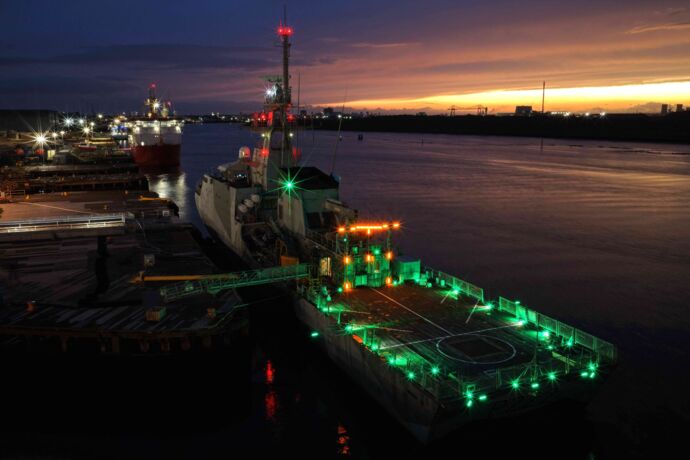
Innovative helicopter landing system installed on third Royal Navy ship at UK Docks
UK Docks Marine Services has helped install an advanced Heli Deck Lighting System on the Royal Navy's HMS Forth, improving helicopters' ability to…

Member Zone
If your company is a member of the Society of Maritime Industries a number of resources are available for which a log-in is required.
LoginResources
Access a wide range of documents, consultations and newsletters which we feel will aid your business activities.
Become a member
We promote the interests of UK based companies in the international market place and to governments
Join Us See the BenefitsNewsletter Signup
Keep up to date with all the latest news and events with our regular newsletter delivered straight to your email box.
Sign Up NowMarine Autonomy Challenge (MAChallenge)
This exciting biennial challenge is open to teams of students studying at UK universities.
Learn more